Thanksgiving Unit Study | 9 Hands-On Ideas Beyond the Turkey
Published:
November 22, 2026

Contributor:
Charis King
Disclosure: This post may contain affiliate links, meaning if you decide to make a purchase via my links, I may earn a commission at no additional cost to you. See my disclosure for more info.
Did your kids just crack the code and escape the Thanksgiving exhibit at the Harvest Hill History Museum? Congratulations! If they’re still talking about leaky ships and secret codes, then it’s the best time to keep learning with these Thanksgiving unit study ideas.
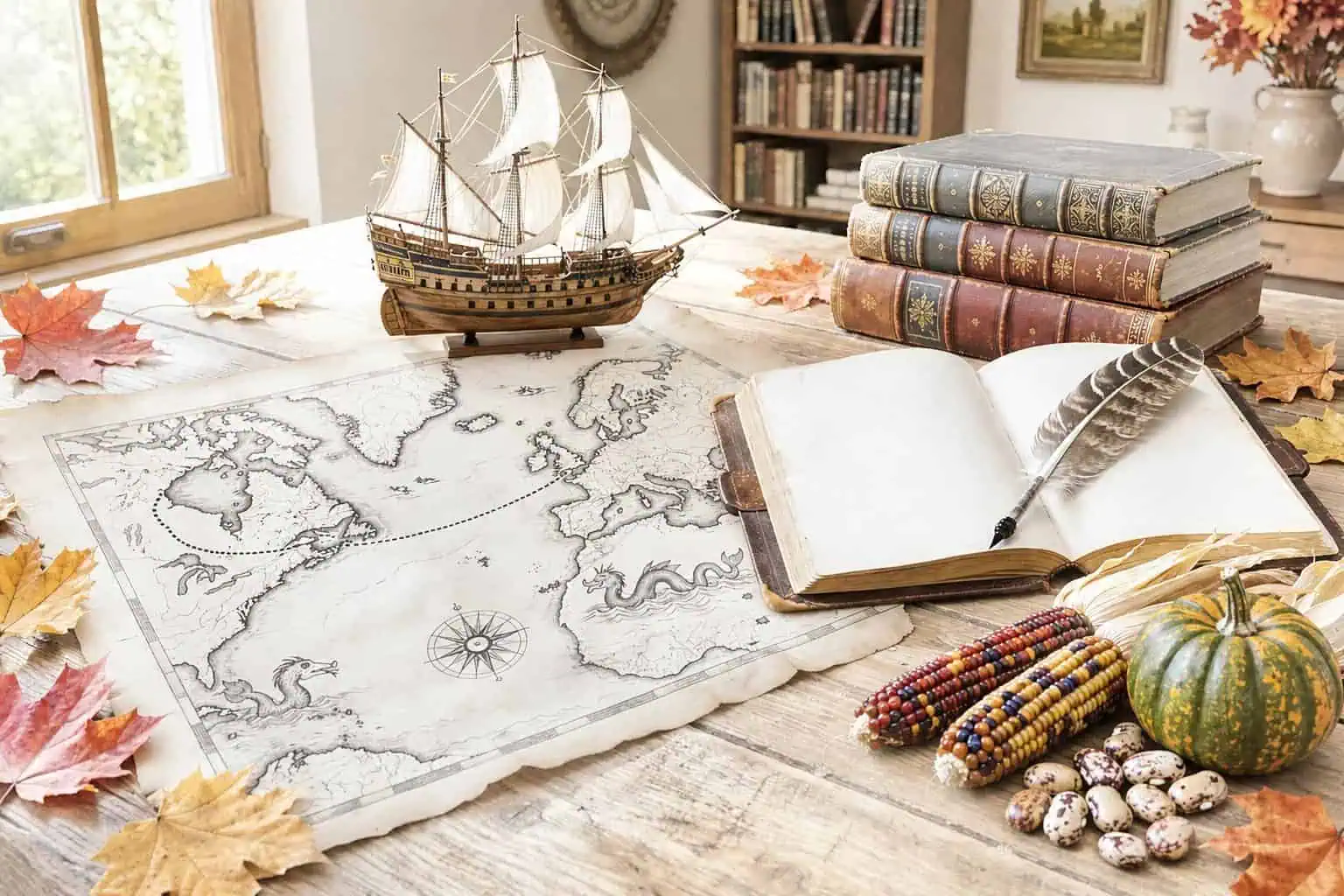
You don’t need to do them all. Pick the one or two that fit your family’s interests and your week. A single afternoon of digging deeper could turn a fun game into something your kids remember for years.
And if you found this page without playing the game, you’re welcome here too! These ideas work as a simple, hands-on Thanksgiving unit study all on their own. The ideas below go hand in hand with our Thanksgiving escape room printable where your junior historians are sealed inside a museum exhibit with 60 minutes to escape. This guide talks about some of the game’s answers, so if your family hasn’t played yet and you want to, then we recommend grabbing the escape room first and save this page for AFTER you play!
Escape the Thanksgiving Exhibit
It’s opening day for the new First Thanksgiving exhibit at the Harvest Hill History Museum, and your kids are the junior historians sealed inside! They have 60 minutes to solve 9 puzzles and escape before the public arrives. For grades 5–6.
1. Mayflower Map Activity: How Fast Did the Mayflower Sail?
If your kids enjoyed the leaky ship and the text-message directions in the first two exhibits, this is a great place to start.
Your kids might be surprised to learn the Mayflower wasn’t supposed to sail alone. A second ship, the Speedwell, set out with it, but it leaked so badly that both ships turned back to England twice. Finally, on September 16, 1620, the Mayflower left Plymouth, England, on its own with 102 passengers.
The crossing was about 3,000 miles and took 66 days. Storms pushed the ship off course, and the passengers landed at Cape Cod instead of Virginia, where they had permission to settle.
Here’s a simple way to bring it to life: pull out a world map or globe and have your kids trace the route from Plymouth, England, to Cape Cod. Then let them do the math. Divide about 3,000 miles by 66 days, and then by 24 hours. They’ll discover the Mayflower averaged about 2 miles per hour, about the speed of walking! That number tends to spark a lot of great questions.
Want to add a little compass practice? Hide a small treat in your yard and give your kids directions like “10 steps north, then 4 steps east” to find it.
A good kids’ world map or globe and an inexpensive [kids’ compass] are all you need for this one.
2. Of Plymouth Plantation for Kids: Start a Colony Journal
Remember Governor Bradford’s journal from Exhibit 3? The real story behind it is a mystery your kids will love.
William Bradford served as governor of Plymouth for about 30 years and wrote the colony’s whole story in a journal called Of Plymouth Plantation. Then the journal went missing! It eventually turned up in a library in London and was finally printed in full in 1856, more than 200 years after Bradford wrote it.
This is a perfect week to have your kids keep their own “colony journal.” Give each child a notebook and invite them to write a few lines each day about what they ate, what work they did, and what they’re thankful for. At the end of the week, ask them to imagine someone reading it 400 years from now. What would that reader learn about your family?
If you have older students, they can read Bradford’s own words free on Project Gutenberg. A simple [kids’ journal] makes this feel extra special.
3. Mayflower Compact Activity and Secret Codes for Kids
Exhibit 4 had your kids decoding a message with an Atbash wheel, so this section is a two-for-one.
Before anyone went ashore in November 1620, 41 men aboard the Mayflower signed an agreement to make fair laws and work together. We call it the Mayflower Compact. You can make this history personal by helping your kids write a family compact with a few fair rules everyone agrees on. Hold a little signing ceremony at dinner. A feather pen makes it even more fun!
And that Atbash wheel? It’s a real code, and an ancient one. People were using it more than 2,000 years ago, and it even appears in the Book of Jeremiah. The idea is simple: A swaps with Z, B swaps with Y, and so on.
Your kids can make their own cipher wheel from two paper plates and trade secret messages all week long. Challenge them to write your whole Thanksgiving menu in code! If your kids get hooked, a [codes and ciphers book for kids] will keep them busy for hours.
4. Who Was Squanto? Follow Tisquantum’s Journey
Most of us grew up hearing his name as Squanto, but his real name was Tisquantum. “Squanto” is a shortened version of it. His story in Exhibit 5 is a moving part of the Thanksgiving story, and it’s worth slowing down for.
In 1614, an English captain named Thomas Hunt kidnapped Tisquantum and other Native men and took them to Spain to be sold. Tisquantum eventually made his way to England, learned English, and finally sailed home in 1619, only to find that sickness had wiped out his entire village of Patuxet. Two years later, he became the translator who helped Massasoit and the Plymouth colonists make peace.
Grab that same map from the Mayflower activity and have your kids trace Tisquantum’s journey: Patuxet to Spain, Spain to England, and England back home. Then compare it to the Mayflower’s single crossing. It’s a powerful way to help kids see the story from a different point of view.
For younger kids, Squanto’s Journey by Joseph Bruchac tells his story in his own voice and makes a wonderful read-aloud.
5. Three Sisters Garden for Kids: Corn, Beans, and Squash Science
If you have a science lover, Exhibit 6 is begging to be explored further!
Native gardeners have planted corn, beans, and squash together for about 3,000 years, because the three plants help each other grow. The corn grows tall and gives the beans something to climb. The beans have tiny bacteria on their roots that pull nitrogen from the air and put it into the soil, feeding the corn and squash. The squash spreads big, prickly leaves that shade the soil, hold in moisture, and keep weeds and hungry animals away.
In the spring, you can plant all three together in a single mound or a large pot. Don’t want to wait that long? Sprout a bean in a clear cup with a damp paper towel. After a few weeks, carefully pull it up and look for little bumps on the roots. That’s where the helpful bacteria live, and kids love finding them!
A Three Sisters seed kit and a kids’ magnifying glass make this one easy.
6. What Did They Eat at the First Thanksgiving? Cook a Harvest Meal
The harvest math in Exhibit 7 was all about food, so why not head to the kitchen?
The only eyewitness account of 1621 tells us the colonists brought in their harvest, four men went out hunting birds, and the Wampanoag brought five deer. You might be surprised that the letter never mentions turkey, pumpkin pie, or cranberry sauce!
Plan a simple “1621 harvest meal” with your kids, like cornbread and a roasted bird, and let them handle the measuring. Doubling or halving a recipe is real-life math, and it’s a lot more fun than a worksheet. A kids’ cookbook can give them ideas to try on their own.
7. Read a First Thanksgiving Primary Source: Edward Winslow’s 1621 Letter
In Exhibit 8, your kids read a shortened version of Edward Winslow’s 1621 letter. Now they can read the real thing!
Winslow’s letter is the only eyewitness description of the harvest celebration we now call the first Thanksgiving. You can find it at Plimoth Patuxet, and Pilgrim Hall Museum shares it beside a second letter from that November.
After you read it together, have your kids make two lists: what Winslow tells us, and what he leaves out. It’s a great way to start a conversation about whose voices are missing from history. And here’s a fun bonus: old printing often uses a long “s” that looks like an “f.” See who can spot one first!
8. Why Are They Called Pilgrims? What the Colonists Called Themselves
The last exhibit asked your kids to find a name for the people of Plymouth, and the real answer might surprise them.
The Mayflower passengers never called themselves “the Pilgrims.” In their own day, the religious group called themselves saints or simply “the church.” Others called them Separatists, because they had separated from the Church of England. Passengers who came for work or land were known as Strangers. And all of them together were colonists: people who left home to settle a new colony that belonged to England.
So where did “Pilgrims” come from? It started with Governor Bradford. Writing about the day the group left their home in Leiden, Holland, he said “they knew they were pilgrims.” He borrowed the word from the Bible (Hebrews 11:13), where a pilgrim is someone on a spiritual journey. He meant it as a description of their faith, not as a name.
For almost 200 years, people mostly called the first settlers the Old Comers or the Forefathers, though a few writers repeated Bradford’s phrase. Then in 1820, at the celebration of Plymouth’s 200th anniversary, the famous speaker Daniel Webster called them the “Pilgrim Fathers.” The name caught on quickly. When Plymouth opened Pilgrim Hall Museum just four years later, in 1824, the name was right there on the building!
Here’s a hands-on way to make it stick: build a “What’s in a Name?” clothesline timeline. Write each name on its own index card: Saints, Separatists, Strangers, Colonists, Old Comers, Forefathers, and Pilgrim Fathers. On the back, add who used the name and roughly when (1620s, 1600s to 1700s, or 1820).
String a piece of yarn across a doorway or wall and have your kids clip the cards in order with clothespins. Then challenge them to sort the cards a second way: names the group used for themselves versus names other people gave them. Seeing that the most famous name came last, about 200 years later, is a real “aha” moment!
Finish with a great dinner-table question: If you had been on the Mayflower, what name would you have wanted people to remember you by, and why?
All you need is a pack of index cards, some yarn, and a few mini clothespins.
9. Visit Plymouth: Pilgrim Hall Museum and Plimoth Patuxet
The Harvest Hill History Museum may be made up, but you can visit the real places that hold this history.
Pilgrim Hall Museum in Plymouth, Massachusetts, has real belongings of the Mayflower passengers, including Governor Bradford’s chair. It opened in 1824 and is the oldest continuously operating public museum in the U.S. Nearby, Plimoth Patuxet Museums brings the 1600s to life with the Historic Patuxet Homesite, a 17th-Century English Village, and the Mayflower II ship. It’s open from spring through the Sunday after Thanksgiving, so check hours before you go.
Can’t make the trip? Plimoth Patuxet’s free You Are The Historian games let your kids investigate the First Thanksgiving and the Mayflower Compact right from home.
Best Thanksgiving Books for Kids, by Age
If your kids want more, these are some of my favorite Thanksgiving books, and together they tell both the English and Wampanoag sides of the story.
- Thank You, Sarah by Laurie Halse Anderson (ages 4 to 8): the funny, true story of the woman who saved Thanksgiving
- Squanto’s Journey by Joseph Bruchac (ages 4 to 8): Tisquantum’s story in his own voice, by an author of Abenaki ancestry
- Mayflower 1620: A New Look at a Pilgrim Voyage by Peter Arenstam, John Kemp, and Catherine O’Neill Grace (ages 6 to 10): real photos of life on board
- Thanksgiving on Thursday by Mary Pope Osborne (ages 7 to 10): a Magic Tree House trip back to 1621
- 1621: A New Look at Thanksgiving by Catherine O’Neill Grace and Margaret M. Bruchac (ages 8 to 12): English and Wampanoag views side by side
- Of Plymouth Plantation by William Bradford (ages 12 and up): the governor’s own history, best for older students and parents
Final Thoughts
The first Thanksgiving is so much more than a single dinner. It’s a story of a leaky ship, a lost journal, ancient codes, a long journey home, and a fragile peace between two very different peoples.
Whether you try one idea or work through them all, you’re giving your kids something wonderful: the chance to see history as a real story about real people. And who knows? Your family might just start a new Thanksgiving tradition along the way.
You Might Also Like…
Charis King
Charis King is the owner & steward of Homeschool Giveaways, a wife whose husband lives in Heaven, and a mom of twin daughters currently attending college. She and her husband homeschooled their daughters with the belief that each person is a unique masterpiece of God – created with gifts, interests and talents. (Eph 2:10). Even though the season of homeschooling her own daughters ended a few years ago, Charis is grateful for the opportunity to support other families along their own unique homeschool journey.